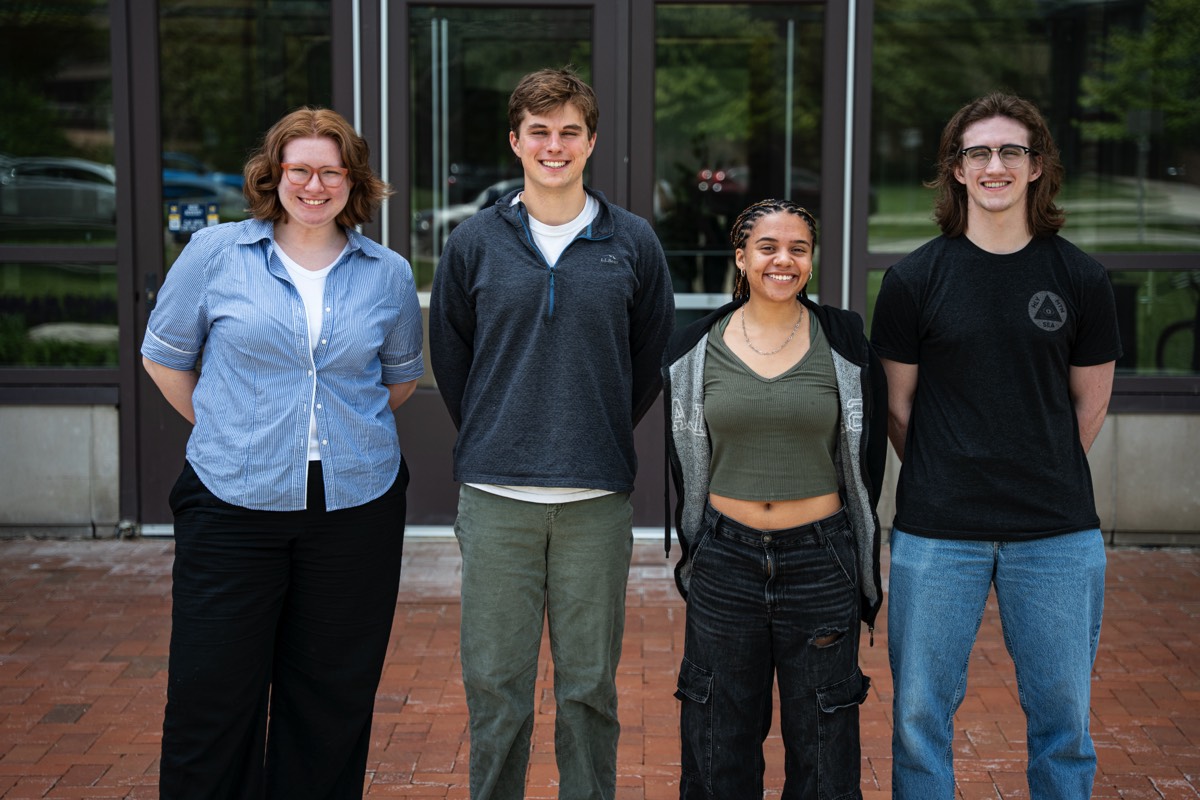
First Week of the Program
Left to Right: Madeline Rehwinkel, John Clinton, Alexis Spence, and Tobias Conover
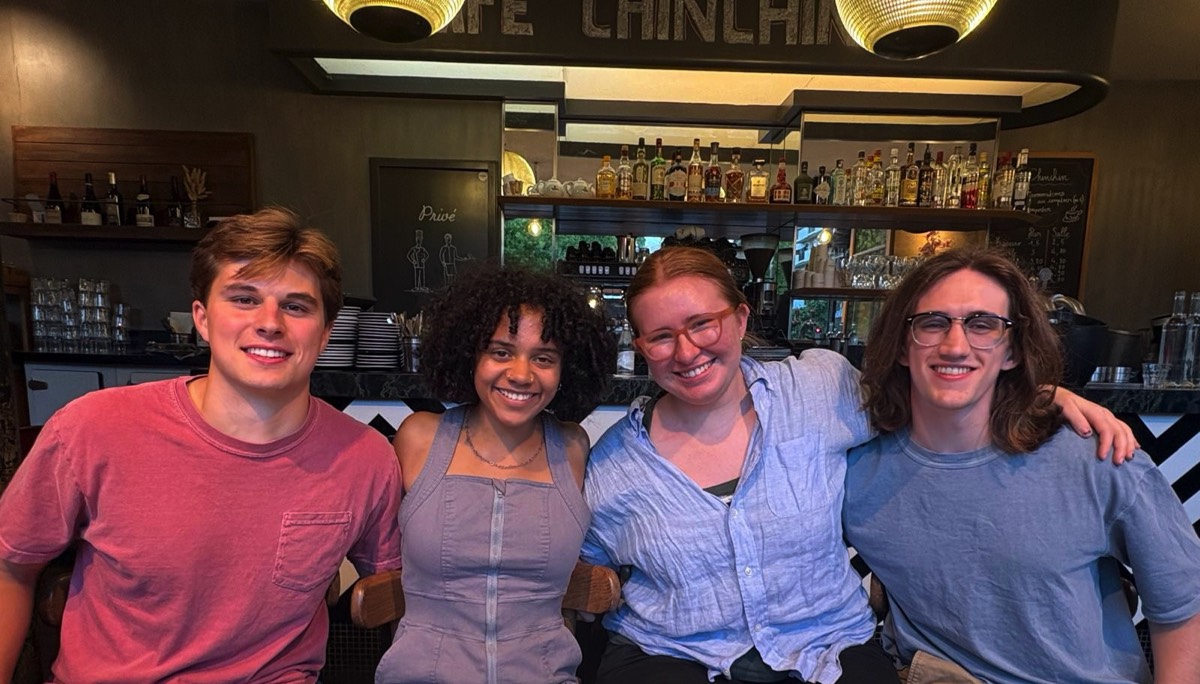
Dinner in Paris
Left to Right: John Clinton, Alexis Spence, Madeline Rehwinkel, and Tobias Conover
2026 Projects
Alexis Spence: Optimization and Characterization of Polymer Based Waveguides
Whiteboard Video:
This summer, in the Optics of the City of Light program I had the opportunity to work with Professor Diep Lai at LuMIN Laboratory, located at Ecole Normale Superior in the University of Paris – Saclay.
My work was associated with the labs research in quantum optics. My project consisted of fabricating and characterizing optical waveguides with the potentially single mode capabilities. This was a brand new area of physics for me, however some of the fabrication elements were similar to processes I had used in the past.
In my first week in the lab, I learned how to fabricate polymer based waveguides. Practicing the procedure first on glass substrates and visually analyzing the structure under a optical microscope with the goal of making a determination of their optical mode. Once my fabrication results were deemed acceptable by professor Lai, I was able to move on to fabricating on silicon wafers.
I found the silicone wafers more difficult for certain steps than the glass for a few reasons. During the spin coating step, the larger size of the wafers made it more difficult to balance on the small base in the machine, and during the high velocity spin the unbalanced forces would send the wafer flying. To solve the issue required some troubleshooting, eventually landing on double sided tape to securely stick the wafer to the base.
Another particular difficulty I had with the silicon wafer substrate was the ability to break the substrate cleanly. The very delicate material required a sharp edge, however many of my attempts resulted in shattering of the disk. Other attempts that broke correctly didn’t break cleanly, which led to inconsistencies in the structures edge.
This project taught me a lot about patience. From the very first steps of fabrication process with the “hurry up and wait” type of procedure, to the delicate optical alignments in my scanning test, things done correctly do not happen quickly. Sometimes I found this very frustrating, but when results could be found or a set up worked correctly it was incredibly satisfying.
I also learned the importance of having PPE material in all labs, even if those in charge may not think it necessary if all procedure are done correctly.
I absolutely enjoyed my time in France. Paris is an incredible city, and I found my self very comfortable with becoming a part of it. This opportunity has instilled confidence in my future goals to return to Europe as a professional, find work, and make a home for myself in a new country across the pond. This project has also been a great success in determining that chemical material based optics may not be the field for me. However, I really enjoyed the laser and quantum components of the work and would consider pursuing work similar to that. Overall this has been an incredible summer and I’m eternally grateful I got to have such a wonderful opportunity.
Top
Madeline Rehwinkel: Rationalizing Optical Storage in Persistent Phosphors for Neuromorphic Computing
Whiteboard Video:
This summer at Ecole Polytechnique, advised by Dr. Victor Castaing, I studied a persistent phosphor material for potential use in all-optical neuromorphic computing. Persistent phosphors are materials with defect energy states within the band gap of a base lattice that allow excited electrons to be trapped and released later, emitting light. This makes persistent phosphors fluoresce after the initial excitation source is removed, also known as glowing in the dark. Neuromorphic computing is an alternative to binary computing that takes positive and negative pulses as inputs and gives pulses of varying strengths as outputs. In neuromorphic computing, the computer is trying to replicate neurons in a brain that can learn and forget with repeated stimulations. The proposed final goal is to synthesize a persistent phosphor material that can be used for this at room temperature; this requires a material for which you can charge the traps with one laser and can discharge the traps with a second laser. However, for current persistent phosphor materials there is enough thermal energy at room temperature to detrap electrons without any optical stimulation.
My project was to determine if lowering the temperature of an existing persistent phosphor sample would allow us to demonstrate the ability of a sample of strontium aluminate with europium and dysprosium codopants, a well-research persistent phosphor, to “learn” and “forget” with repeated optical stimulations. First, I measured the intensity of emitted photoluminescence (PL) while charging the sample with an ultraviolet laser and then during discharging of the sample when the laser was turned off. This was completed at 5 temperatures ranging from -75C to 20C (room temperature) to determine at which temperature there was a low enough detrapping rate. I worked to write a curve-fitting script to fit the charging and discharging PL and extract the detrapping rates; I did not finish this script in time so I could only start to fit some of the data I collected. Qualitatively, a suitable temperature was determined to be -50C. Then working at this low temperature, I took measurements of the emitted PL when pulsing the ultraviolet laser and found that the intensity of the PL peaks increased with the number of applied laser pulses. This shows the sample “learning” from previous excitations. Then when the sample had reached an equilibrium with the UV laser applied, pulses of an infrared laser were applied to the sample. This resulted in PL peaks of decreasing intensity, showing the phosphors “forgetting” from negative stimulations. Thus at -50C we indeed had suitable conditions to show that the current sample could be applied in neuromorphic computing.
I have previously done a lot of curve-fitting and programming in Python, so I came in believing this would be an easier part of my project. However, I was pleasantly surprised to be very challenged by writing the curve-fitting script. I had not worked in MATLAB before, so that was a new challenge, but also this was much more complicated than any curve-fitting I had done before. The model itself was complex, and for the fitting I wrote my own objective function to calculate the sum of the difference of squares with custom weights. In addition, the logic of the program to customize the inputs to be usable for different datasets was very difficult, but very rewarding, to figure out.
This summer I also learned a lot about taking optical measurements. I was lucky to be able to use a setup that was already built so I didn’t need to do a lot of setting up. However, I did get the chance to help align a laser and install a sliding optical density filter to assist with my measurements. A few times a measurement would fail because I had forgotten to check a detail or secure some part of the setup. So, throughout the summer I became more thorough and precise, which resulted in better measurement outcomes.
I also learned more about controlling equipment through different methods. To pulse the two lasers, we used an electromagnet connected to a shutter, which was controlled by a python script that I would load in a terminal window. While I did not write this script, I had not controlled any equipment through terminal commands before so that was a good learning experience for me. Additionally, to cool the sample down and heat it up we used a temperature-controlled stage that was operated by a program from the manufacturer on a separate computer. I used this for all my measurements, so I got very comfortable setting it up and controlling it with the computer.
Top
John Clinton: Studying Embedded V-defects in Green LEDs with Scanning Tunneling Microscopy
Whiteboard Video:
This summer I researched under Dr. Alistair Rowe in Laboratoire de Physique de la Matière Condensée at École Polytechnique. My goal was to locate embedded V-defects in a InGaN green LED using a scanning tunneling microscope, which I was able to do by examining their electrical injection and electroluminescence characteristics.
I worked on two experiments before the one in which I found the V-defects. In the first, I looked at spectra from varied currents in two scenarios; a macroscopic bias across the LED, and a microscopic bias with the tip acting as a p-type contact. We hoped to see a shoulder or blue shift in the spectra, evident of a V-defect. We also hoped to see the External Quantum Efficiency (EQE) reach the droop regime. I coded these in python, but did not see what we hoped to find.
Our second experiment was designed to create spectra at 1024 points in a 32x32 grid in a 1.66μm x 1.66μm scan. By doing this, we can Gaussian fit each spectra and map the intensity, energy, and width of the spectra at each point. A previous PhD student did this, so I was able to adapt her code to my work. This did not show V-pits, but did show our experiment ran properly.
Our third experiment hoped to locate the V-defects in the topography, and then locate them electrically. We somehow were able to locate them in the topography (despite V-defects being embedded, perhaps showing that they get ‘charged’)but knowing WHY we could locate them was a mystery. On my own, I was tasked with (1) Finding V-defects in the topography, then (2) setting up a measurements at points in a 32x32 grid, measuring tunneling current and emitted photons as a function of voltage as we swept it from -2.0 to -10.0 V using the STM. Lastly, (3) I was to analyze this data in python to look for V-defects. I adapted the code from the previous experiment to this one, and was able to map current at a set voltage, voltage to reach a set current, and photons emitted at a set voltage. In my maps I found the V-defects! They also matched the locations of the v-defect shaped features we saw in the topography, further validating our results. This was especially rewarding for me since I did most of this experiment by myself. Dr. Rowe and Dr. Alyabyeva were out of the office for a week and a half, meaning I was the one setting it up, monitoring it, and treating the data from the STM.
Beyond optics, I learned about myself a great deal. Living in a new continent where I did not know the language forced me out of my comfort zone on a daily basis. I resented this at first, but grew to appreciate it and leaned into it towards the end. I also found that the harder I worked and better I focused, the better my results were. I also learned how to recognize when my mind is wandering and not to let my actions wander as a result of my wandering thoughts. This allowed me to focus, and to endure when I was facing adversity or plateaus in my work. I am very proud of the quality of work I produced this summer, and am thankful for both the opportunity and for the people that made my first research opportunity so enjoyable and memorable.
This opportunity gave me a better grasp of what ‘research’ entails as well as what I enjoyed and did not so much enjoy about certain fields as I apply to grad school. I enjoyed that I could see the LED light up; I’ve always liked tangible and visual physics. I also appreciated the connection my research has to understanding mechanisms responsible for efficient green LEDs, which can be used to make efficient white LEDs and contribute to a sustainable future.
Top
Tobias Conover Characterization of Balanced Homodyne Detector (BHD) Properties
Whiteboard Video:
This summer, I had the privilege of spending two months in France doing optics research at Telecom Paris under the guidance of Dr. Juan Rafael Alvarez. My project was to explore the methods used in the characterization of properties of Balanced Homodyne Detectors (BHDs). The lab I worked in is interested in applying these detectors for applications in quantum optics. In this application, signals of light from two sources can be mixed, split, and then compared by the BHD. The BHD can subtract the signals, eliminating any noise or signal fluctuations common to both signals. What was left behind is a signal influenced by the electronic noise of the BHD and signal fluctuations uncommon to both signals. These uncommon signal fluctuations are due to the quantum nature of light.
The characteristics I examined were shot noise, clearance, common mode rejection ratio (CMRR), and bandwidth. Shot noise showed how the subtracted signal changed when the signal intensity increased. Clearance determines how susceptible signals are to electronic noise by taking the difference between electronic noise and shot noise. CMRR quantifies how well the BHD was subtracting signals, and bandwidth determines the range of frequencies that could accurately be measured.
Initially, there was a BHD made by Telecom that they wanted to characterize. It was quickly discovered that this detector was susceptible to outside noise and needed some modifications. These modifications never made it back in time for further testing. As a result, we pivoted to characterizing different photodiodes and BHDs available. None of these detectors had good characteristics for the lab’s future goals, but I was still able to explore the characterization methods we wanted, which made the project a success.
I got to apply my knowledge of Fourier transforms and Mathematica to convert data from the time domain to the frequency domain. Since we were testing a variety of detectors, I also got plenty of hands-on experience with free space and fiber optics. Something Juan would regularly do was to give me new equipment to try, like motorized half-wave plate mounts, which let me practice independently understanding and implementing new equipment. Additionally, I got exposure to quantum optics through this research. I learned that this may be an area I would like to pursue further in graduate school.
Lastly, this program allowed me to learn about myself and grow as an individual. As the program went on, I found myself gaining confidence in myself as I navigated challenging situations (like ordering food or navigating public transportation to an unfamiliar place). Additionally, this program let me get to know some very wonderful people, both inside the program and outside of it. I grew very close with the people in this program as we faced similar challenges and did many things together. The people in my lab were very welcoming, and we would occasionally get dinner, go to events, or play board games after work. They would often give good suggestions for places to go. Getting these experiences and connections gave me a deeper appreciation for France and the people.
Top
Whiteboard Video:
This summer, in the Optics of the City of Light program I had the opportunity to work with Professor Diep Lai at LuMIN Laboratory, located at Ecole Normale Superior in the University of Paris – Saclay.
My work was associated with the labs research in quantum optics. My project consisted of fabricating and characterizing optical waveguides with the potentially single mode capabilities. This was a brand new area of physics for me, however some of the fabrication elements were similar to processes I had used in the past.
In my first week in the lab, I learned how to fabricate polymer based waveguides. Practicing the procedure first on glass substrates and visually analyzing the structure under a optical microscope with the goal of making a determination of their optical mode. Once my fabrication results were deemed acceptable by professor Lai, I was able to move on to fabricating on silicon wafers.
I found the silicone wafers more difficult for certain steps than the glass for a few reasons. During the spin coating step, the larger size of the wafers made it more difficult to balance on the small base in the machine, and during the high velocity spin the unbalanced forces would send the wafer flying. To solve the issue required some troubleshooting, eventually landing on double sided tape to securely stick the wafer to the base.
Another particular difficulty I had with the silicon wafer substrate was the ability to break the substrate cleanly. The very delicate material required a sharp edge, however many of my attempts resulted in shattering of the disk. Other attempts that broke correctly didn’t break cleanly, which led to inconsistencies in the structures edge.
This project taught me a lot about patience. From the very first steps of fabrication process with the “hurry up and wait” type of procedure, to the delicate optical alignments in my scanning test, things done correctly do not happen quickly. Sometimes I found this very frustrating, but when results could be found or a set up worked correctly it was incredibly satisfying.
I also learned the importance of having PPE material in all labs, even if those in charge may not think it necessary if all procedure are done correctly.
I absolutely enjoyed my time in France. Paris is an incredible city, and I found my self very comfortable with becoming a part of it. This opportunity has instilled confidence in my future goals to return to Europe as a professional, find work, and make a home for myself in a new country across the pond. This project has also been a great success in determining that chemical material based optics may not be the field for me. However, I really enjoyed the laser and quantum components of the work and would consider pursuing work similar to that. Overall this has been an incredible summer and I’m eternally grateful I got to have such a wonderful opportunity.
Top
Madeline Rehwinkel: Rationalizing Optical Storage in Persistent Phosphors for Neuromorphic Computing
Whiteboard Video:
This summer at Ecole Polytechnique, advised by Dr. Victor Castaing, I studied a persistent phosphor material for potential use in all-optical neuromorphic computing. Persistent phosphors are materials with defect energy states within the band gap of a base lattice that allow excited electrons to be trapped and released later, emitting light. This makes persistent phosphors fluoresce after the initial excitation source is removed, also known as glowing in the dark. Neuromorphic computing is an alternative to binary computing that takes positive and negative pulses as inputs and gives pulses of varying strengths as outputs. In neuromorphic computing, the computer is trying to replicate neurons in a brain that can learn and forget with repeated stimulations. The proposed final goal is to synthesize a persistent phosphor material that can be used for this at room temperature; this requires a material for which you can charge the traps with one laser and can discharge the traps with a second laser. However, for current persistent phosphor materials there is enough thermal energy at room temperature to detrap electrons without any optical stimulation.
My project was to determine if lowering the temperature of an existing persistent phosphor sample would allow us to demonstrate the ability of a sample of strontium aluminate with europium and dysprosium codopants, a well-research persistent phosphor, to “learn” and “forget” with repeated optical stimulations. First, I measured the intensity of emitted photoluminescence (PL) while charging the sample with an ultraviolet laser and then during discharging of the sample when the laser was turned off. This was completed at 5 temperatures ranging from -75C to 20C (room temperature) to determine at which temperature there was a low enough detrapping rate. I worked to write a curve-fitting script to fit the charging and discharging PL and extract the detrapping rates; I did not finish this script in time so I could only start to fit some of the data I collected. Qualitatively, a suitable temperature was determined to be -50C. Then working at this low temperature, I took measurements of the emitted PL when pulsing the ultraviolet laser and found that the intensity of the PL peaks increased with the number of applied laser pulses. This shows the sample “learning” from previous excitations. Then when the sample had reached an equilibrium with the UV laser applied, pulses of an infrared laser were applied to the sample. This resulted in PL peaks of decreasing intensity, showing the phosphors “forgetting” from negative stimulations. Thus at -50C we indeed had suitable conditions to show that the current sample could be applied in neuromorphic computing.
I have previously done a lot of curve-fitting and programming in Python, so I came in believing this would be an easier part of my project. However, I was pleasantly surprised to be very challenged by writing the curve-fitting script. I had not worked in MATLAB before, so that was a new challenge, but also this was much more complicated than any curve-fitting I had done before. The model itself was complex, and for the fitting I wrote my own objective function to calculate the sum of the difference of squares with custom weights. In addition, the logic of the program to customize the inputs to be usable for different datasets was very difficult, but very rewarding, to figure out.
This summer I also learned a lot about taking optical measurements. I was lucky to be able to use a setup that was already built so I didn’t need to do a lot of setting up. However, I did get the chance to help align a laser and install a sliding optical density filter to assist with my measurements. A few times a measurement would fail because I had forgotten to check a detail or secure some part of the setup. So, throughout the summer I became more thorough and precise, which resulted in better measurement outcomes.
I also learned more about controlling equipment through different methods. To pulse the two lasers, we used an electromagnet connected to a shutter, which was controlled by a python script that I would load in a terminal window. While I did not write this script, I had not controlled any equipment through terminal commands before so that was a good learning experience for me. Additionally, to cool the sample down and heat it up we used a temperature-controlled stage that was operated by a program from the manufacturer on a separate computer. I used this for all my measurements, so I got very comfortable setting it up and controlling it with the computer.
Top
John Clinton: Studying Embedded V-defects in Green LEDs with Scanning Tunneling Microscopy
Whiteboard Video:
This summer I researched under Dr. Alistair Rowe in Laboratoire de Physique de la Matière Condensée at École Polytechnique. My goal was to locate embedded V-defects in a InGaN green LED using a scanning tunneling microscope, which I was able to do by examining their electrical injection and electroluminescence characteristics.
I worked on two experiments before the one in which I found the V-defects. In the first, I looked at spectra from varied currents in two scenarios; a macroscopic bias across the LED, and a microscopic bias with the tip acting as a p-type contact. We hoped to see a shoulder or blue shift in the spectra, evident of a V-defect. We also hoped to see the External Quantum Efficiency (EQE) reach the droop regime. I coded these in python, but did not see what we hoped to find.
Our second experiment was designed to create spectra at 1024 points in a 32x32 grid in a 1.66μm x 1.66μm scan. By doing this, we can Gaussian fit each spectra and map the intensity, energy, and width of the spectra at each point. A previous PhD student did this, so I was able to adapt her code to my work. This did not show V-pits, but did show our experiment ran properly.
Our third experiment hoped to locate the V-defects in the topography, and then locate them electrically. We somehow were able to locate them in the topography (despite V-defects being embedded, perhaps showing that they get ‘charged’)but knowing WHY we could locate them was a mystery. On my own, I was tasked with (1) Finding V-defects in the topography, then (2) setting up a measurements at points in a 32x32 grid, measuring tunneling current and emitted photons as a function of voltage as we swept it from -2.0 to -10.0 V using the STM. Lastly, (3) I was to analyze this data in python to look for V-defects. I adapted the code from the previous experiment to this one, and was able to map current at a set voltage, voltage to reach a set current, and photons emitted at a set voltage. In my maps I found the V-defects! They also matched the locations of the v-defect shaped features we saw in the topography, further validating our results. This was especially rewarding for me since I did most of this experiment by myself. Dr. Rowe and Dr. Alyabyeva were out of the office for a week and a half, meaning I was the one setting it up, monitoring it, and treating the data from the STM.
Beyond optics, I learned about myself a great deal. Living in a new continent where I did not know the language forced me out of my comfort zone on a daily basis. I resented this at first, but grew to appreciate it and leaned into it towards the end. I also found that the harder I worked and better I focused, the better my results were. I also learned how to recognize when my mind is wandering and not to let my actions wander as a result of my wandering thoughts. This allowed me to focus, and to endure when I was facing adversity or plateaus in my work. I am very proud of the quality of work I produced this summer, and am thankful for both the opportunity and for the people that made my first research opportunity so enjoyable and memorable.
This opportunity gave me a better grasp of what ‘research’ entails as well as what I enjoyed and did not so much enjoy about certain fields as I apply to grad school. I enjoyed that I could see the LED light up; I’ve always liked tangible and visual physics. I also appreciated the connection my research has to understanding mechanisms responsible for efficient green LEDs, which can be used to make efficient white LEDs and contribute to a sustainable future.
Top
Tobias Conover Characterization of Balanced Homodyne Detector (BHD) Properties
Whiteboard Video:
This summer, I had the privilege of spending two months in France doing optics research at Telecom Paris under the guidance of Dr. Juan Rafael Alvarez. My project was to explore the methods used in the characterization of properties of Balanced Homodyne Detectors (BHDs). The lab I worked in is interested in applying these detectors for applications in quantum optics. In this application, signals of light from two sources can be mixed, split, and then compared by the BHD. The BHD can subtract the signals, eliminating any noise or signal fluctuations common to both signals. What was left behind is a signal influenced by the electronic noise of the BHD and signal fluctuations uncommon to both signals. These uncommon signal fluctuations are due to the quantum nature of light.
The characteristics I examined were shot noise, clearance, common mode rejection ratio (CMRR), and bandwidth. Shot noise showed how the subtracted signal changed when the signal intensity increased. Clearance determines how susceptible signals are to electronic noise by taking the difference between electronic noise and shot noise. CMRR quantifies how well the BHD was subtracting signals, and bandwidth determines the range of frequencies that could accurately be measured.
Initially, there was a BHD made by Telecom that they wanted to characterize. It was quickly discovered that this detector was susceptible to outside noise and needed some modifications. These modifications never made it back in time for further testing. As a result, we pivoted to characterizing different photodiodes and BHDs available. None of these detectors had good characteristics for the lab’s future goals, but I was still able to explore the characterization methods we wanted, which made the project a success.
I got to apply my knowledge of Fourier transforms and Mathematica to convert data from the time domain to the frequency domain. Since we were testing a variety of detectors, I also got plenty of hands-on experience with free space and fiber optics. Something Juan would regularly do was to give me new equipment to try, like motorized half-wave plate mounts, which let me practice independently understanding and implementing new equipment. Additionally, I got exposure to quantum optics through this research. I learned that this may be an area I would like to pursue further in graduate school.
Lastly, this program allowed me to learn about myself and grow as an individual. As the program went on, I found myself gaining confidence in myself as I navigated challenging situations (like ordering food or navigating public transportation to an unfamiliar place). Additionally, this program let me get to know some very wonderful people, both inside the program and outside of it. I grew very close with the people in this program as we faced similar challenges and did many things together. The people in my lab were very welcoming, and we would occasionally get dinner, go to events, or play board games after work. They would often give good suggestions for places to go. Getting these experiences and connections gave me a deeper appreciation for France and the people.
Top